Global X Canada launched DRAM.TO on the TSX on September 22, and yes, it has the same ticker as the popular Roundhill US memory ETF. Since its launch, the Roundhill version has grown its assets to over US$26 billion. Both are a bet on continued demand and high pricing of memory chips and storage drives. So when you type DRAM into your broker, are you getting the same thing?
SEction 1
What does each fund hold?
Global X’s DRAM.TO is an index fund, tracking the Mirae Asset Artificial Intelligence Memory Index, which holds up to 10 stocks. Companies get sorted into two buckets: memory chip makers (DRAM and NAND flash) and makers of data storage hardware (hard drives and storage systems). The index takes up to five stocks from each bucket, ranked by the dollar size of their memory revenue. Weights are based on free-float market capitalization with a 25% cap on a single stock.
In contrast, Roundhill’s DRAM is an actively managed fund. Roundhill’s managers have discretion over the stocks and the weights. Eligible stocks must have at least half of their revenue or profit from memory business, and have a market capitalization of at least US$10 billion. Weights are based on each company’s market share and share of memory revenue, although no actual formula is provided. There is no limit on the number of stocks it can hold.
Both can include Chinese stocks. However, the Mirae index used by DRAM.TO only includes Chinese stocks that are either listed in Hong Kong, or mainland shares available through Stock Connect. Stock Connect is a link between the Hong Kong and mainland Chinese exchanges. CXMT, the Chinese memory maker that has recently IPOed in Shanghai, is not yet available on Stock Connect, so it is not yet part of DRAM.TO.
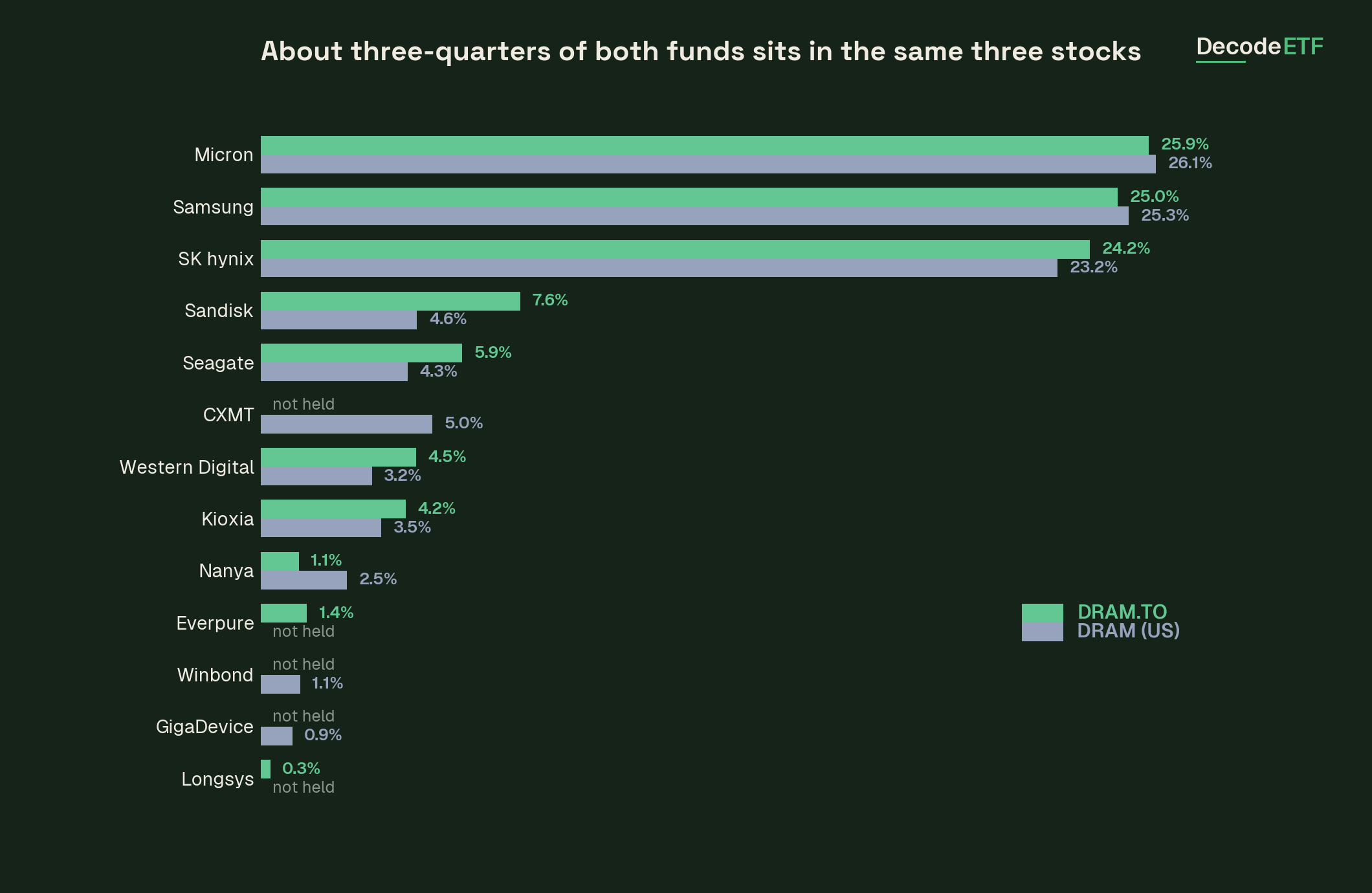
Figure 1
Weight of each company as a share of each fund. DRAM.TO: index weights on October 2, 2026. US DRAM: shares plus swaps, from Roundhill's holdings file for October 2, 2026.
Figure 1 shows the top holdings in each version of DRAM. The big three are the same: Micron, Samsung and SK hynix are about three-quarters of each fund, and about half of each fund is South Korea. The differences are at the edges. US DRAM has 5% in CXMT through a swap, while DRAM.TO has none. DRAM.TO leans harder into storage and flash: Sandisk 7.6% against 4.6%, Seagate 5.9% against 4.3%.
SECTION 2
What do the differences mean for you?
Rules or judgment: DRAM.TO runs on a published rulebook. You can see why a stock is in and when that can change. Market-value weighting means winners automatically get bigger. US DRAM is a bit of a black box. You trust that Roundhill’s fund managers would make the right calls as things change. The upside is speed. For example, CXMT listed in Shanghai on July 27 and US DRAM already holds it. DRAM.TO cannot yet, because CXMT wasn't on the Stock Connect approved list as of September 30.
Shares or swaps: A total return swap is a contract with a bank, where the bank pays the fund the total returns of the underlying stocks while the fund pays the bank financing costs. While DRAM.TO directly holds stocks, US DRAM holds a mix of stocks and swaps. 42% of US DRAM is swaps, including almost all of its Micron and all of its CXMT. With a swap, you're exposed to the stock as well as the bank issuing the swap.
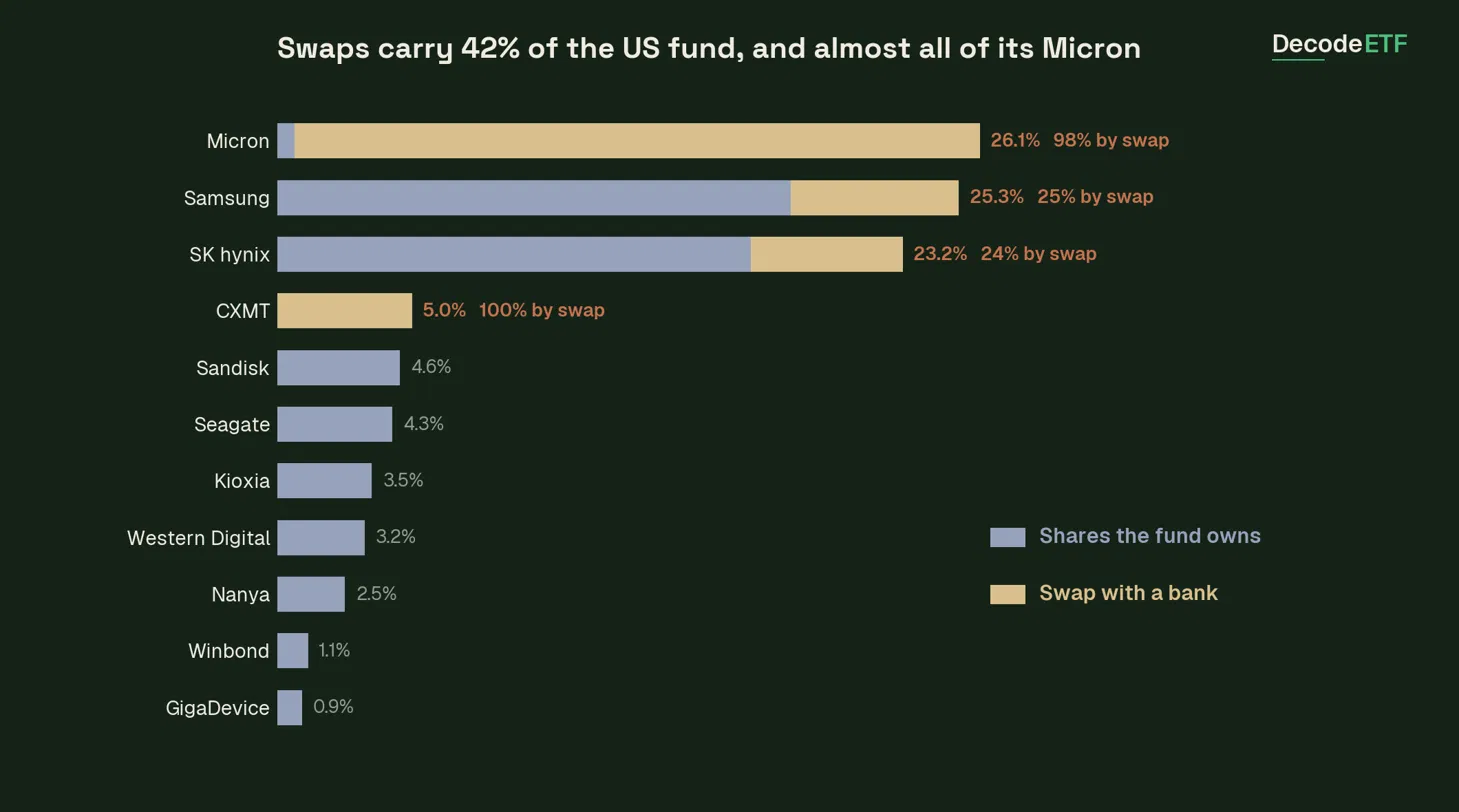
Figure 2
Share of each company held as shares or through swaps, US DRAM, October 2, 2026. Swaps are 42.4% of the fund's exposure. Roundhill also keeps about 38% of the fund in Treasury bills and a money market fund for cash and collateral.
Tax: Both funds hold foreign companies, so both lose some dividends to foreign withholding tax. In DRAM.TO, a non-registered account can claim that back as a credit. In US DRAM, Canadians generally can't recover tax withheld inside the fund, in any account. That said, the underlying stocks barely pay dividends. Samsung pays about 0.5% a year, SK Hynix 0.2%, Micron 0.05%, and Sandisk and Kioxia pay nothing. Therefore, the tax advantage of DRAM.TO over US DRAM will be smal, unless there are special one-time dividends.
Fees: The management fee for DRAM.TO is 0.49%. The MER is not available yet as it is too new. US DRAM has an expense ratio of 0.65% but that number does not include financing costs on the total return swaps it has on Micron, Samsung, SK Hynix, and CXMT. Roundhill does earn interest on the cash backing the swaps, so the net impact on the cost of the swaps is less clear.
Size: DRAM.TO has just launched so the fund is still tiny. A small fund can have a wide gap between the buy and sell price, so look at the bid and ask before you trade.
Section 3
Conclusion
The key takeaway is that DRAM.TO is simpler and cheaper, but tiny and brand new. US DRAM is bigger and more of a black box, with about two-fifths of it sits in swaps. Tax treatment does not matter much unless there is a special dividend. Before you buy either one, check which DRAM is on your screen.
ETF insights, straight to your inbox
We break down what Canadian ETF investors need to know. Free. No account needed. Unsubscribe anytime.